
 Log In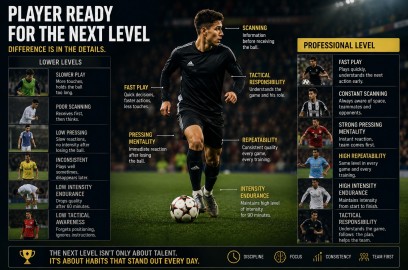
Many players think being ready for higher football means:
-
scoring goals
-
making highlights
-
looking technical in warm-up videos
But professional clubs usually look for something deeper.
Because the higher the level—
the faster football exposes weaknesses.
A player “ready for the next level” often has specific habits and qualities that immediately stand out.
Not only talent.
Football behavior.
-
FAST PLAY — NOT JUST FAST FEET
Many lower-league players hold the ball too long.
At professional level—
time disappears.
Players who are ready for higher football:
-
play quickly
-
simplify under pressure
-
know the next action early
-
move the ball before pressure arrives
This does not mean “panic football”.
It means fast thinking.
In lower leagues:
???? more touches
???? more time
???? more freedom
At higher levels:
???? less time
???? faster pressure
???? faster punishment for mistakes
-
SCANNING BEFORE RECEIVING
This is one of the biggest differences between levels.
Professional players constantly scan:
-
before receiving
-
while moving
-
before turning
-
before passing
Why?
Because football is easier
when information arrives early.
Many lower-level players receive first
and think later.
Higher-level players often think first
and receive already prepared.
That changes everything.
-
PRESSING MENTALITY
Modern football is brutal without intensity.
Professional coaches expect players to react immediately after losing the ball.
Not walk.
Not complain.
Not stop.
Pressing today is not “extra work”.
It is basic responsibility.
Lower levels often allow:
???? slower reactions
???? passive defending
???? moments of rest
Higher levels punish that instantly.
Players ready for higher football usually press naturally.
Without being forced every time.
-
REPEATABILITY
One good action means little.
Professional football values repeatability.
Can you:
-
repeat intensity?
-
repeat decision-making?
-
repeat concentration?
-
repeat quality under fatigue?
Many players look excellent for 10 minutes.
Professional clubs want players
who maintain level for 90.
And then repeat it again three days later.
-
ABILITY TO HANDLE HIGH INTENSITY
The difference between lower football and professional football is not only quality.
It is sustained intensity.
At higher levels:
-
transitions are faster
-
pressing is stronger
-
tempo is constant
-
recovery time is smaller
Some players technically look good—
until the game speeds up.
Then:
-
touches become worse
-
decisions slow down
-
positioning disappears
-
concentration drops
Players ready for higher football maintain quality even when the game becomes chaotic.
-
TACTICAL RESPONSIBILITY
This is huge.
Many talented players struggle higher up because they think football is only about freedom.
Professional football values structure.
Coaches notice quickly:
-
positioning
-
discipline
-
reaction to tactical instructions
-
understanding of space
-
defensive responsibility
At lower levels, individual quality sometimes solves problems.
At higher levels, tactical mistakes destroy teams.
That is why responsible players gain trust faster.
THE BIGGEST DIFFERENCE BETWEEN LOWER LEVELS AND PROFESSIONAL FOOTBALL
Lower football often rewards moments.
Professional football rewards consistency.
At lower levels:
???? talent can dominate games alone
At higher levels:
???? details decide everything
-
first touch
-
scanning
-
transitions
-
pressing
-
positioning
-
mentality
-
reactions
That is why many technically gifted players struggle when moving up.
The game becomes too fast for their habits.
FINAL MESSAGE
A player ready for the next level usually does not look spectacular every second.
But coaches quickly notice:
-
speed of thinking
-
discipline
-
intensity
-
repeatability
-
tactical understanding
-
mentality under pressure
Because those qualities survive when football becomes harder.
And that is the real difference between:
“a talented player”
and
“a player ready for professional football”.
SUPPORT FOR PLAYERS
For 6 years, we have been helping less-known players completely for free — guiding them, giving honest feedback, and creating real football opportunities. During this time, we have completed over 25 player transfers to clubs across Europe.
If you value our work and want to help us continue supporting players worldwide, you can support us here:
https://suppi.pl/footballtalentstube77
Every supporter will have the chance to speak personally with me —
I will check your level, give you real feedback, and guide you individually.
The most determined players receive invitations for official trials.
Rejection is not the end.
It’s your beginning.