
 Log In
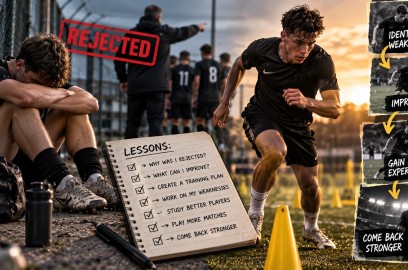
You attended a trial.
You gave everything.
But the club rejected you.
Maybe a coach told you that you weren't good enough.
Maybe an academy released you.
Or perhaps you contacted 20 clubs and nobody offered you an opportunity.
WHAT HAPPENS NEXT?
Many players become angry, lose confidence or blame other people.
But ambitious footballers should ask a different question:
WHAT CAN THIS REJECTION TEACH ME?
Here are 7 ways to turn rejection into real football development.
-
ASK WHY YOU WERE REJECTED
Don't leave a trial without trying to understand what went wrong.
Ask the coach:
"What are the two most important things I need to improve?"
Maybe you lack speed, physical strength, tactical understanding or consistency.
Not every club will provide feedback, but when you receive it, use it.
-
SEPARATE YOUR EMOTIONS FROM THE FACTS
Being rejected hurts.
But rejection doesn't always mean you are a bad footballer.
Sometimes a club needs a different type of player.
Sometimes your level is simply not high enough yet.
Learn to recognise the difference.
DON'T IGNORE CRITICISM JUST BECAUSE IT HURTS.
-
TURN CRITICISM INTO A TRAINING PLAN
A coach says your first touch is too slow?
Don't spend the next month complaining.
Spend it improving your first touch.
Practise receiving under pressure, controlling difficult passes and preparing your next action.
Choose two weaknesses and work on them for 30 days.
Measure your progress.
-
STUDY THE PLAYERS WHO WERE SELECTED
Someone else received the contract you wanted.
Instead of becoming jealous, study that player.
What did they do better?
Were they faster?
Did they make better decisions?
Were they more effective in their position?
Their performance can show you what the club expects.
-
STOP REPEATING THE SAME MISTAKES
Imagine attending five trials and being rejected five times.
If you never change your preparation, why should the sixth trial be different?
After every unsuccessful opportunity, write down:
-
What went well?
-
What went wrong?
-
What must improve?
-
What will I do differently next time?
Rejection becomes valuable only when you change something.
-
FIND A LEVEL WHERE YOU CAN DEVELOP
You wanted to join a professional club, but they rejected you.
Perhaps your next step should be a strong semi-professional team.
Regular competitive matches can help you develop abilities that you cannot improve while sitting on the bench.
Don't be ashamed of taking a smaller step.
YOUR NEXT CLUB SHOULD HELP YOU BECOME A BETTER PLAYER.
-
PROVE YOUR IMPROVEMENT ON THE PITCH
You don't need to convince everyone that they made a mistake.
You need to become a better footballer.
After 60 or 90 days, compare your performances.
Are you making faster decisions?
Are you losing the ball less often?
Are you more effective against stronger opponents?
If the answer is yes, you are moving forward.
Even if you haven't received a contract yet.
FINAL MESSAGE
Harry Kane was released by Arsenal as a child.
Jamie Vardy played non-league football before reaching the Premier League.
Their stories are different, but they teach an important lesson.
REJECTION DOES NOT HAVE TO END YOUR JOURNEY.
However, rejection alone will not make you stronger.
You must learn from it.
Change your habits.
Improve your weaknesses.
And prove your progress through performances.
Remember:
BEING REJECTED TEN TIMES AND LEARNING NOTHING IS NOT PROGRESS.
BEING REJECTED ONCE, IDENTIFYING YOUR WEAKNESSES AND IMPROVING THEM CAN CHANGE YOUR FUTURE.
Don't make your next goal simply to find another trial.
MAKE YOUR NEXT GOAL TO BECOME A BETTER FOOTBALLER BEFORE THAT TRIAL.
SUPPORT FOR PLAYERS
For 6 years, we have been helping less-known players completely for free, completing over 25 transfers to European clubs.
If you value our work, you can support Football Talents Tube.
Supporters can speak with me personally, receive honest feedback and individual guidance. The most determined players receive invitations for official trials.